Europe
-
Spain
History of Spain
Brief history of Spain summarized A brief and enjoyable review of the long history of Spain. Old spain Starting in 900 BC, a seafaring people called the Phoenicians who came from what is now Lebanon traded with what is now Spain. They founded a chain of trading settlements along the coast, on islands and peninsulas. The Iberians gave the Phoenicians silver in exchange for wine and olive oil, as well as jewelry. The people of Spain were highly influenced by the Phoenician culture. The Greeks also traded with Spain, the Iberians were also influenced by Greek culture. A Phoenician colony…
Read More » -
Traditions and customs of Spain
What traditions and customs are there in Spain? With an ancient history, the customs and traditions of Spain. Gastronomy Food in daily life The traditional Spanish diet is based on the products of an agrarian, livestock and horticultural society. The main staple foods are bread (wheat is preferred); legumes (chickpeas, broad beans, lentils); rice; garden vegetables; cured pork products; lamb and veal (and beef, in many newly sought after regions); the eggs; farmyard animals (chickens, rabbits, pigeons). Wild herbs available in the area, game, fish and shellfish; salted fish (especially cod and congréola); olives and olive oil; orchard fruits and…
Read More » -
Slovenia
Slovenia language
The Republic of Slovenia is a country belonging to Europe, whose capital is Ljubljana. It has a population of 2 million inhabitants (144º) and an area of 20,273 km 2 (151º). Its human development index is very high (25º) and its official currency is the euro. And what language is spoken in Slovenia? What language do they speak in Slovenia? Slovenia has one official language, Slovene. Likewise, Italian and Hungarian are considered official languages in the respective regions where there is a large ethnic mix with Slovenes. These areas are located on the borders with Italy and Hungary, respectively. Such…
Read More » -
History of Slovenia
Brief history of Slovenia summarized A brief review of the summarized history of Slovenia, a European country. Slovenian Principles Around 3,500 stone age farmers lived in what is now Slovenia. The bronze age followed from 750 BC the iron age. Then, around 400 BC, the Celts settled in Slovenia. They formed the state of Noricum. However, in 10 BC the Romans conquered Slovenia. Under Roman rule, Slovenia prospered and cities such as Emona (Ljubljana), Celeia (Celje), and Poetovio (Ptuj) were founded. However, Roman rule collapsed in the 5th century AD In the 6th century AD the Slavs arrived in Slovenia.…
Read More » -
Traditions and customs of Slovenia
What traditions and customs are there in Slovenia? We observe the customs and traditions of Slovenia. Gastronomy Food in daily life Slovenia has a rich culinary tradition that is a product of both its climate and its location at the crossroads of Central Europe. Slovenian culinary heritage reflects Mediterranean, Alpine and Eastern European cultures. Meals are an important part of Slovenian family life, and enjoying a sandwich or a glass of wine in a café with friends is a typical social activity. Although each region of Slovenia has its own specialties, most of the oldest traditional Slovenian dishes are prepared…
Read More » -
Traditions and customs of Slovakia
What traditions and customs are there in Slovakia? Let’s get to know the customs and traditions of Slovakia from the inside. Gastronomy Food in daily life Slovak food exhibits a lot of regional variation, but is generally based on soups, cooked and boiled vegetables, cooked fruits, smoked meats (especially sausages), roast meats, porridge, and dairy dishes. Sheep’s cheese with dumplings, bryndzové halušky, is one of the most typical dishes in Slovakia. Traditionally in peasant households, five meals were eaten: early in the morning upon rising (raňajky), a snack at ten o’clock in the morning (“desiata”), the main meal of the…
Read More » -
Scotland

Scotland language
Scotland is one of the four nations that make up the United Kingdom. They belong to Europe, and their capital is Edinburgh. It has a population of 5.5 million inhabitants and an area of 77,933 km 2. Its human development index is very high and its official currency is the pound sterling. And what language is spoken in Scotland? What language do they speak in Scotland? Scotland officially recognizes three languages: English , spoken by 99% of the population. Scots , which is spoken by 30% of its inhabitants. Scottish Gaelic, which is spoken by 1.1% of citizens. The main…
Read More » -
History of Scotland
Brief history of Scotland summarized A brief and pleasant review of the history of Scotland summarized. Ancient Scotland During the ice age, Scotland was uninhabited. However, when the ice melted the forests that spread across Scotland and stone age hunters moved there. In 6,000 BC, small groups of people lived in Scotland hunting animals such as red deer and seals and gathering plants for food. Then around 4,500 BC farming was introduced to Scotland. Early farmers continued to use stone tools and weapons and this period is called the Neolithic (new stone age). Neolithic people used stone or fire axes…
Read More » -
Scottish traditions and customs
What traditions and customs are there in Scotland? A brief overview of the customs and traditions of Scotland, a British country. Food and economy Food in daily life The diet includes prepared foods and a greater variety of fruits and vegetables. Meals such as minced meat and tats (ground meat and boiled or mashed potatoes) and homemade curries are common, along with takeout options. The Scots are heavy consumers of sugar, chocolate, salt and butter, but have recently started eating less meat and more fish, wholemeal bread and vegetables. Food customs on ceremonial occasions Whiskey often serves as a symbolic…
Read More » -
Denmark
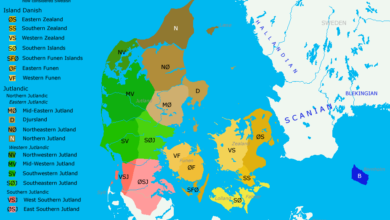
Denmark language
The Kingdom of Denmark is a country belonging to Northern Europe, whose capital is Copenhagen. It has a population of 6 million inhabitants (112º) and an extension of 42,933 km 2 (130º). Its human development index is very high (11th) and its official currency is the Danish crown. But what language is spoken in Denmark? What language do they speak in Denmark? Denmark has only one official language, Danish. Likewise, Denmark recognizes three languages: Faroese, which is spoken by 21,000 inhabitants, is co-official in the Faroe Islands. Greenlandic, spoken by as few as 7,000 people, is the sole official language…
Read More »