Africa
-
Ethiopia

Typical Ethiopian food
Geographic setting and environment Located in East Africa, Ethiopia (formerly called Abyssinia) covers an area of approximately 1,127,127 square kilometers. Comparatively, the area occupied by Ethiopia is slightly less than twice the size of the state of Texas. Ethiopia is a country of geographical contrasts, ranging from 125 meters below sea level in the Denakil Depression to more than 4,600 meters above sea level in the mountainous regions. It contains a variety of different topographic zones: the Great Rift Valley runs the entire length of the country in a northeast-southwest direction; the Ethiopian Highlands are marked by mountain ranges; the…
Read More » -
Ethiopia
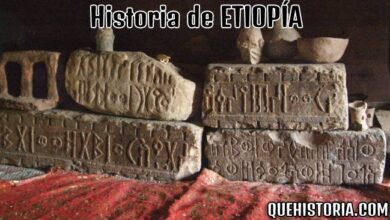
History of Ethiopia
Brief history of Ethiopia summarized A brief summary of the history of Ethiopia, a country belonging to Africa. Ancient Ethiopia People have lived in Ethiopia for thousands of years. However, the first well-known kingdom in Ethiopia arose in the 1st century AD Around 100 AD there was a kingdom in Ethiopia called Axum. Axum traded with Rome, Arabia, and India. Axum converted to Christianity in the 4th century AD In 642 the Arabs conquered Egypt. In 698-700 they took Tunis and Carthage and soon controlled the entire North African coast. The Arabs were Muslim, of course, and soon the entire…
Read More » -
Traditions and customs of Ethiopia
What traditions and customs are there in Ethiopia? Here we can see the customs and traditions of Ethiopia. Gastronomy Food in daily life Injera, a fluffy unleavened bread made from teff grain, is the staple of every meal. All foods are eaten with the hands, and injera pieces are cut into bite-sized pieces and used to dip and grab stews (“wat”) made from vegetables such as carrots and cabbage, spinach, potatoes, and lentils. The most common spice is berberey, which has a red pepper base. Food taboos found in the Old Testament are observed by most people as prescribed by…
Read More » -
Cape Verde language
The Republic of Cape Verde is an island country in West Africa, whose capital is Praia. It has a population of 550,000 inhabitants (167th) and an area of 4,033 km 2 (166th). Its human development index is medium (125º) and its official currency is the Cape Verdean escudo. But what language is spoken in Cape Verde? What language do they speak in Cape Verde? The official language of Cape Verde is Portuguese. However, it is not the most popular language of the islands, since the most widely spoken language in Cape Verde is Cape Verdean Creole, recognized as the national…
Read More » -
Traditions and customs of Cape Verde
What traditions and customs are there in Cape Verde? A look at the customs and traditions of Cape Verde, a former colony of Portugal. Food and economy Food in daily life Corn is the staple food of Cape Verde. The national dish, cachupa, is a stew of corn, beans, and whatever meat or vegetable is available. Other common foods include rice, beans, fish, potatoes, and cassava. A traditional breakfast is couscous, a steamed cornbread, eaten with honey and milk or coffee. Cape Verdeans usually eat a large mid-afternoon lunch and a small late dinner. Grog, or sugarcane liquor, is made…
Read More » -
Traditions and customs of Botswana
What traditions and customs are there in Botswana? A look at the customs and traditions that exist in Botswana, an African country. Food and economy Food in daily life Sorghum or maize porridge is the staple of most Botswana meals. People wake up in the morning to a thinner version of oatmeal, sometimes spiked with sour milk and/or sugar, and tea. A thicker version of porridge, known as bogobe, anchors the hearty midday meal, accompanied by a stew of meat and/or cabbage, spinach (or wild greens), or beans. People also use rice, but it is considered more expensive and associated…
Read More » -
Botsuana

History of Botswana
Brief history of Botswana summarized A brief tour of the history of Botswana summarized. Old Botswana Botswana’s earliest inhabitants were Stone Age hunter-gatherers. Some hunters continued their simple way of life into the 20th century. However, in the years before the birth of Christ, some converted to a pastoral way of life. Then after 500 AD the Bantu migrated to Botswana. They were dedicated to livestock and brought iron tools and weapons. After AD 1000 the herdsmen formed organized kingdoms. Then, in the 13th century, a powerful chiefdom arose with its capital on the Mapungubwe hill. However, they were overshadowed…
Read More » -
Algeria

Typical Algerian food
Geographic setting and environment Algeria is located in North Africa, on the Mediterranean Sea. The fertile and mountainous northern region is home to olive trees, cork oaks and vast evergreen forests where wild boars and jackals roam. In the warmer areas grow fig trees, agaves and several palm trees. The vine is native to the coastal plain. Central Algeria is made up of high plateaus containing salt marshes and dry or shallow salt lakes. The land becomes more arid (dry) as you go south, eventually becoming the Sahara desert. About 80 percent of the country is desert, where vegetation is…
Read More » -
Traditions and customs of Angola
What traditions and customs are there in Angola? Angola, a country that was colonized by Portugal, is a nation with promising potential. We present the customs and traditions of Angola. Food and economy Food in daily life More than half of the population is unemployed and it is estimated that 70 percent of the population lives below the poverty line. Hunger is a threat in many areas. As normal economic activities are impossible in many regions, local eating habits are hardly distinguishable. The coastal population includes a lot of seafood in their diet, pastoralists in the Southwest rely primarily on…
Read More » -
Zambia

Zambian History
Brief history of Zambia summarized A brief review of the history of Zambia, an African country, in a summarized way. Zambia in ancient times At the time of Christ, the people of Zambia were Bushmen, stone age hunters and gatherers. They hunted antelope with bows and arrows. They also caught smaller animals and gathered fruit and nuts and caterpillars and locusts. They led a semi-nomadic lifestyle and made windbreaks out of stones and branches, or if they stayed in one area for a while, they made huts out of bent poles and straw grass. Around the 4th century AD a…
Read More »