Africa
-
Kenya

Kenyan language
The Republic of Kenya is a country belonging to Africa, whose capital is Nairobi. It has a population of 50 million inhabitants (28th) and an area of 580,367 km 2 (48th). Its human development index is medium (142º) and its official currency is the Kenyan shilling. But what language is spoken in Kenya? What language do they speak in Kenya? Kenya has two official languages: Swahili, spoken by 37.1% of the population. English , which is spoken by 18.8% of the inhabitants. Both languages serve as the lingua franca throughout the country. While in rural areas most of the population…
Read More » -
History of Kenya
Brief history of Kenya summarized A brief review of the history of Kenya, a country on the African continent. The Kenyan Principles The earliest inhabitants of Kenya were hunter-gatherers, but from about 2,000 BC pastoralists arrived in the region. Then, from 800 AD, the Arabs set sail for Kenya. Some settled and intermarried and created the Swahili culture along the coast. The first European to arrive in Kenya was Vasco da Gama in 1498. Subsequently, the Portuguese dominated the Kenyan coast for two centuries. However, they did not penetrate inland. However, the Portuguese brought new crops to Kenya, maize and…
Read More » -
Kenyan traditions and customs
What traditions and customs are there in Kenya? We reveal the customs and traditions of Kenya, an African country. Gastronomy Food in daily life Maize (or maize) is the staple food of Kenyans. It is ground into flour and prepared as a porridge called posho, which is sometimes mixed with mashed beans, potatoes, and vegetables, to make a dish called irio. Another popular food is a beef stew called ugali. This is eaten in a large pot and each diner takes a piece of ugali, which they use as a spoon to scoop up beans and other vegetables. Boiled vegetables,…
Read More » -
Egypt
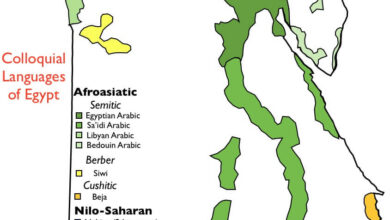
Egypt language
The Arab Republic of Egypt is a country belonging to Africa, whose capital is Cairo. It has a population of 95 million inhabitants (14th) and an area of 1,010,408 km 2 (29th). Its human development index is medium (115º) and its official currency is the Egyptian pound. But what language is spoken in Egypt? What language do they speak in Egypt? Egypt has only one official language, Arabic. The most widely spoken languages in Egypt are: Egyptian Arabic (68%), Saidi Arabic (29%), Bedawi Arabic (1.6%), Domari (0.3%), Nobiin (0.3%), Beya (0,1%). The most common immigrant languages are Greek, Armenian, Italian,…
Read More » -
Egypt

Flora and fauna of Egypt
Flora of Egypt The Egyptian flora is represented by a wide variety of desert plants and trees, unique desert flowers and herbs. The Nile Delta is a green oasis where many kinds of beautiful flowering trees and shrubs are easily found. Variety of plants The Lotus and the Papyrus were the symbols of Lower and Upper Egypt during the time of the Pharaohs and we know from the Holy Quran that Egypt was famous for vegetables such as onions, garlic and lentils. Now palm trees dominate the landscape. The Nile Delta and Nile River Valley have a rich variety of…
Read More » -
History of Egypt
Brief history of Egypt summarized A brief journey through the history of Egypt, from Ancient Egypt to the present day. Ancient Egypt By 5,000 BC the people of Egypt had begun farming. They also weaved linen and made pottery. Later they learned to wear bronze. Around 3,200 BC the Egyptians invented writing. The first Egyptian in history was King Menes, alias Narmer, who lived shortly before 3,100 BC. At that time Egypt was divided into the north (lower) and the south (upper). Around 3118 Menes managed to unite the two. He made Memphis his capital. Ancient Egypt was a highly…
Read More » -
Traditions and customs of Egypt
What traditions and customs are there in Egypt? Overview of the customs and traditions of Egypt. Gastronomy Food in daily life Eating is an important social activity, and it is essential to mark special events and ceremonial occasions. The most important food in daily life is sliced bread. In rural areas, women often bake bread in clay ovens in their homes. In the cities, bread is sold in bakeries. Standard bread is strictly regulated by the government in terms of weight and price, and is one of the few items that still receives a subsidy from the state. Indigenous cuisine…
Read More » -
Traditions and customs of Tanzania
What traditions and customs are there in Tanzania? We observe the customs and traditions of Tanzania. Gastronomy Food in daily life For most Tanzanians, including those living in urban areas, no meal is complete without their favorite staple carbohydrates: corn, rice, cassava, sorghum, or bananas, for example. Bananas are preferred in the Northwest, ugali (a thick mixture of maize or sorghum) in the Central and Southwest regions, and rice in the South and along the coast. The staple food is accompanied by a stew of fish, beef, goat, chicken, or lamb or fried pieces of meat, along with various types…
Read More » -
Traditions and customs of Algeria
What traditions and customs are there in Algeria? A review of the customs and traditions of the North African country, Algeria. Food and economy Food in daily life The national dish of Algeria is couscous, steamed wheat semolina served with lamb or chicken, cooked vegetables and sauce. This is so basic to the Algerian diet that its Arabic name, ta’am, translates to “food.” Common flavors include onions, turnips, raisins, chick peas, and red bell peppers, as well as salt, pepper, cumin, and coriander. Alternatively, couscous can be served sweet, flavored with honey, cinnamon or almonds. Lamb is also popular, and…
Read More » -
South African traditions and customs
What traditions and customs are there in South Africa? A review of the customs and traditions of South Africa, the southernmost country on the African continent. Gastronomy Food in daily life It consists of the traditionally simple food of starches and meats characteristic of an agricultural and frontier society. The early pioneer farmers of Afrikaner sometimes subsisted entirely on meat when conditions for the grain trade were not favourable. There is only one specialty cuisine on the Cape, with its mix of Dutch, English and South East Asian cuisine. Food plays a central role in family and community life for…
Read More »