-
History of Romania
Brief history of Romania summarized Brief and pleasant walk in the history of Romania, the country of Count Dracula. Old Romania The first inhabitants of Romania were stone age hunters who lived around 8,000 BC Over time, the people of Romania learned to farm and then learned to make bronze tools. They eventually learned to use iron. From about 600 BC the ancient Greeks traded with the people they called Getae. They founded settlements on the coast of Romania. The Romans called the people of Romania Dacians. In 101-102 AD the Roman Emperor Trajan led a campaign against the Dacians.…
Read More » -
Traditions and customs of Romania
What traditions and customs are there in Romania? To know the customs and traditions of Romania. Gastronomy Food in daily life Breakfast is usually a small meal of bread and butter, jam, and tea. Most of the food is eaten in the early afternoon. Mititei, grilled sausage seasoned with garlic, is a common appetizer. Borsch, cabbage soup with bran, or ciorba, a soup of lamb, mushrooms, and other meats and vegetables, is often served as a first course. Main dishes are usually meat-based, such as tocana, a pork stew seasoned with garlic and onion. Other popular dishes include sarmale, cabbage…
Read More » -
Traditions and customs of Costa Rica
What traditions and customs are there in Costa Rica? We discover the customs and traditions of Costa Rica. Gastronomy Food in daily life Corn is consumed in the form of tortillas, which accompany rice and beans; They are normally eaten three times a day with eggs, cheese, meat or chicken and with chayote stew or salad for lunch or dinner. The midday meal was once the biggest, but the long lunch break has succumbed to the fast-food craze. Beverages include coffee, sugary fruit drinks, and soft drinks. Alcohol consumption is high. Food customs on ceremonial occasions Savory snacks are served…
Read More » -
Ivory Coast
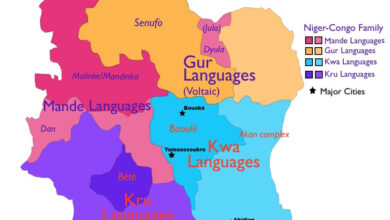
Ivory Coast language
The Republic of Ivory Coast is a country belonging to Africa, whose capitals are Yamoussoukro (political) and Abidjan (economic). It has a population of 24 million inhabitants (54th) and an area of 322,463 km 2 (68th). Its human development index is low (170º) and its official currency is the West African CFA franc. And what language is spoken in the Ivory Coast? What language do they speak in Ivory Coast? Ivory Coast has one official language, French. However, some 84 other languages coexist in the country (75 of them indigenous), the most common being yulá (or diula), generally used in…
Read More » -
Traditions and customs of the Ivory Coast
What customs and traditions are there in Ivory Coast? Explanation of the traditions and typical customs of the Ivory Coast (Africa). Food and economy Food in daily life In Côte d’Ivoire, grains such as millet, maize, and rice, and tubers such as yams and cassava make up the majority of meals. These staples are supplemented with legumes such as peas, beans, or peanuts, and smaller amounts of vegetables, oils, spices, and protein, usually meat or fish. The women prepare the grains by grinding them in large wooden bowls with long wooden pestles. For the most part, family meals are cooked…
Read More » -
Korean History (South/North)
Brief history of Korea (North and South) summarized A brief review of the history of both Koreas, both North and South, in an entertaining and summarized way. Ancient Korea In 4000 BC there were stone age farmers living in Korea. Around the year 1000 BC they had already learned to use bronze. By 300 BC they had learned to use iron to make tools and weapons. At first, Korea was divided into tribes, but over time organized kingdoms emerged. There were three of them, Goguryeo in the north and Silla and Baekje in the south. According to legend, Silla was…
Read More » -
South Korea
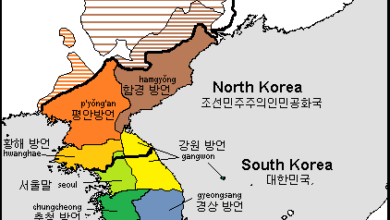
South Korean language
The Republic of Korea is a country in East Asia, and its capital is Seoul. It has a population of more than 51 million inhabitants (27th) and an area of 100,363 km2 (107th). Its human development index is very high (22nd) and its official currency is the South Korean won. And what language is spoken in South Korea? What language do they speak in South Korea? South Korea has one official language, Korean. In education, English is a compulsory subject, while Japanese or Mandarin Chinese are optional. Approximately 10% of the South Korean population can speak English well; most of…
Read More » -
Traditions and customs of South Korea
What traditions and customs are there in South Korea? From East Asia and North Korea’s northern neighbor, the customs and traditions of South Korea. Gastronomy Food in daily life The rapid changes in lifestyles that have accompanied economic development since the 1960s have changed the traditional pattern of eating rice with every meal. Some urbanites can eat toast, eggs, and milk for breakfast, using a fork and knife. However, for many people, a bowl of steamed white rice, a vegetable soup with soybean paste and a bowl of kimch’I can still be the basic daily meal, to which vegetables, fish,…
Read More » -
North Korean traditions and customs
What traditions and customs are there in North Korea? The northern part introduces us to the customs and traditions of North Korea. Gastronomy Food in daily life White rice and beef soup was once a symbol of fine dining in North Korean rhetoric. It is uncertain whether the population continues to eat (steamed) white rice due to severe food shortages that have become apparent in recent years. Visitors from abroad normally receive abundant food, including meat, vegetables, dairy products and fruits. However, ordinary citizens do not eat such a wide variety of foods. In addition, the North Korean diet does…
Read More » -
Korea

Korean music
Korean music is a mix of Chinese and Japanese influences and indigenous elements. Although it was primarily an independent state (except during the colonization of the Mongol Empire or a dependent state of the Chinese Empire for a short period of time and finally during the colonization of the Japanese Empire in 1910), Korea has been divided into two since the War of Korea, but its traditional music and culture remain the same. The only difference comes from the western capitalist influence on modern music in the South, and the western communist influence in the North. Korean traditional music (gugak)…
Read More »