-
France

French music
The music of France reflects a wide variety of styles. In the field of classical music, France has produced several prominent romantic composers, while folk and popular music has seen the rise of the chanson and cabaret style. The world’s first known sound recording device, the phonograph, was patented in France by Édouard-Léon Scott de Martinville in 1857. France is also the fifth largest market by value in the world, and its music industry has produced many artists. Internationally renowned, especially in new song and electronic music. The history of French music dates back to the organ in the 10th…
Read More » -
Traditions and customs of France
What traditions and customs are there in France? Extensive explanation of the duties, customs and traditions of France, a European country. Gastronomy Food in daily life Food plays an important role in the country’s social life. Wine and cheese are a source of national pride and reflect regional differences. Meals are ritualized and full of social and cultural meaning. There are also political aspects in the meaning of food. For example, recently there has been much concern about the quality of “engineered” foods and a rejection of foods that have been genetically altered. Another recent concern was vache folle (mad…
Read More » -
Finland

Language of Finland
The Republic of Finland is a country belonging to Europe, a member of the European Union, whose capital is Helsinki. It is the 111th most populous country (5.5 million) and the 65th largest (338,145 km 2). Its human development index is very high (22nd) and its official currency is the euro. But what language is spoken in Finland? What language do they speak in Finland? Finland has two official languages: Finnish (or Finnish), which is the native language of 89% of the population. Swedish , which is spoken natively by 5.3% of the population. In northern Finland, in Lapland, there…
Read More » -
Finland
History of Finland
Brief history of Finland summarized If you are interested in knowing a little more about the history of Finland, you are in the right place. Former finland The first humans arrived in Finland around 7,000 BC after the end of the last ice age. The early Finns were stone age hunters and gatherers. For thousands of years, successive waves of people migrated to Finland. From the year 2,500 BC, the population of Finland began to live from agriculture. Around 1500 BC they learned to make bronze tools and weapons. Around the year 500 BC in the Finnish lands they learned…
Read More » -
Finnish traditions and customs
What traditions and customs are there in Finland? Finland (suomi) as a nation has existed for not long. However, it has always been inhabited by people who have forged centuries-old traditions and varied customs. Food Food in daily life Milk is prominent in the diet as a beverage and the staple ingredient in a variety of curdled, sour, and cultured forms; in broths used for soups, stews and puddings; and in special regional dishes such as ‘cheese bread’ (‘juustoleipä’). There are notable differences between western and eastern Finland in bread making and in the way milk is made bitter. A…
Read More » -
Philippines

Philippines language
The Republic of the Philippines is a country in Southeast Asia, whose capital is Manila. It has a population of 107 million inhabitants (12th) and an area of 300,000 km 2 (72nd). Its human development index is medium (113º) and its official currency is the Philippine peso. And what language is spoken in the Philippines? What language do they speak in the Philippines? The Philippines is a very linguistically diverse country with 183 living languages (175 of them are indigenous languages). The Philippines has 2 official languages since the 1987 Constitution: Filipino , spoken by 45.7% of the population. English…
Read More » -
History of the Philippines
Brief history of the Philippines summarized A brief review of the summarized history of the Philippines, an Asian archipelago. The beginning of the Philippines The Philippines is named after King Philip II of Spain (1556-1598) and was a Spanish colony for more than 300 years. Today the Philippines is an archipelago of 7,000 islands. However, it is believed that during the last ice age they were linked to the Asian mainland via a land bridge, allowing humans to walk from there. The first people in the Philippines were hunter-gatherers. However, between 3,000 BC and 2,000 BC, people learned to farm.…
Read More » -
Philippine traditions and customs
What traditions and customs are there in the Philippines? In Southeast Asia, the customs and traditions of the Philippines. Gastronomy Food in daily life Filipinos do not consider it a meal if rice is not served. Steamed rice is the basis of the diet. Three crops a year are harvested to provide enough rice for the population, and the government keeps the surplus in storage for times of drought. Saltwater and freshwater from fish and shellfish are consumed daily, whether fresh or salty. Fish, chicken and pork are often fried, although people are becoming more health-conscious and often choose alternative…
Read More » -
Europe
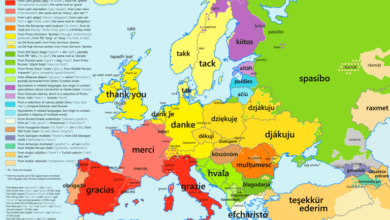
What languages are spoken in Europe?
Most of the languages of Europe belong to the Indo-European family. Out of a total population of 740 million, there are 94% native speakers of some Indo-European language. Within this, the three largest groups are the Slavic, Germanic and Romance languages, with more than 200 million speakers each, representing a total of 90% of European languages. Other small groups of languages are Greek (10 million), Baltic (7 million), Albanian (5 million), Romani (1.5 million), and Celtic (1 million). And what languages are spoken in Europe? Most spoken languages in Europe Sort from highest to lowest number of native speakers in…
Read More » -
Ethiopia

Typical Ethiopian food
Geographic setting and environment Located in East Africa, Ethiopia (formerly called Abyssinia) covers an area of approximately 1,127,127 square kilometers. Comparatively, the area occupied by Ethiopia is slightly less than twice the size of the state of Texas. Ethiopia is a country of geographical contrasts, ranging from 125 meters below sea level in the Denakil Depression to more than 4,600 meters above sea level in the mountainous regions. It contains a variety of different topographic zones: the Great Rift Valley runs the entire length of the country in a northeast-southwest direction; the Ethiopian Highlands are marked by mountain ranges; the…
Read More »